 Hudoori
Working Hours and Overtime Calculation Under Saudi Labor Law
A practical guide to working hours under Saudi labor law, including Ramadan, and how to calculate overtime pay with a clear worked example. Plus tips for organizing shifts and breaks and calculating them automatically.
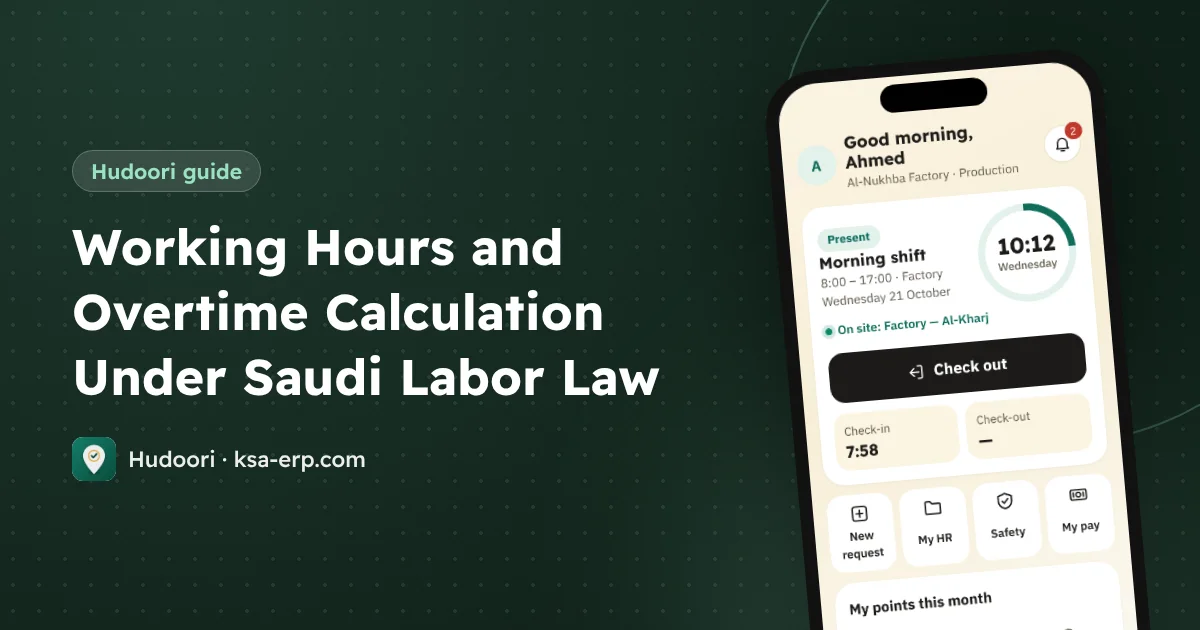
Under Saudi labor law, standard working hours are 8 hours a day or 48 hours a week, reduced during Ramadan for Muslim employees to 6 hours a day or 36 hours a week. Anything beyond that is overtime, paid at the hourly wage plus 50% of the basic wage. Here's how to apply that in practice without calculation errors.
Daily and weekly limits
The law sets two limits at once. Your schedule has to respect both: a 48-hour week doesn't make an unrecorded long day acceptable. Common compliant patterns are six days of 8 hours (typical in factories and contracting) or five days of 8 hours (common in offices).
Whatever pattern you use, put it in the contract and your company's work regulation, and make sure employees know it before they start.
Ramadan hours
During Ramadan, Muslim employees work 6 hours a day or 36 hours a week. Plan for it before the month begins:
- Set new start and end times for each shift.
- In mixed teams, non-Muslim employees stay on their normal hours unless the company decides otherwise.
- Announce the new schedule in advance and update your lateness settings.
How to calculate overtime pay
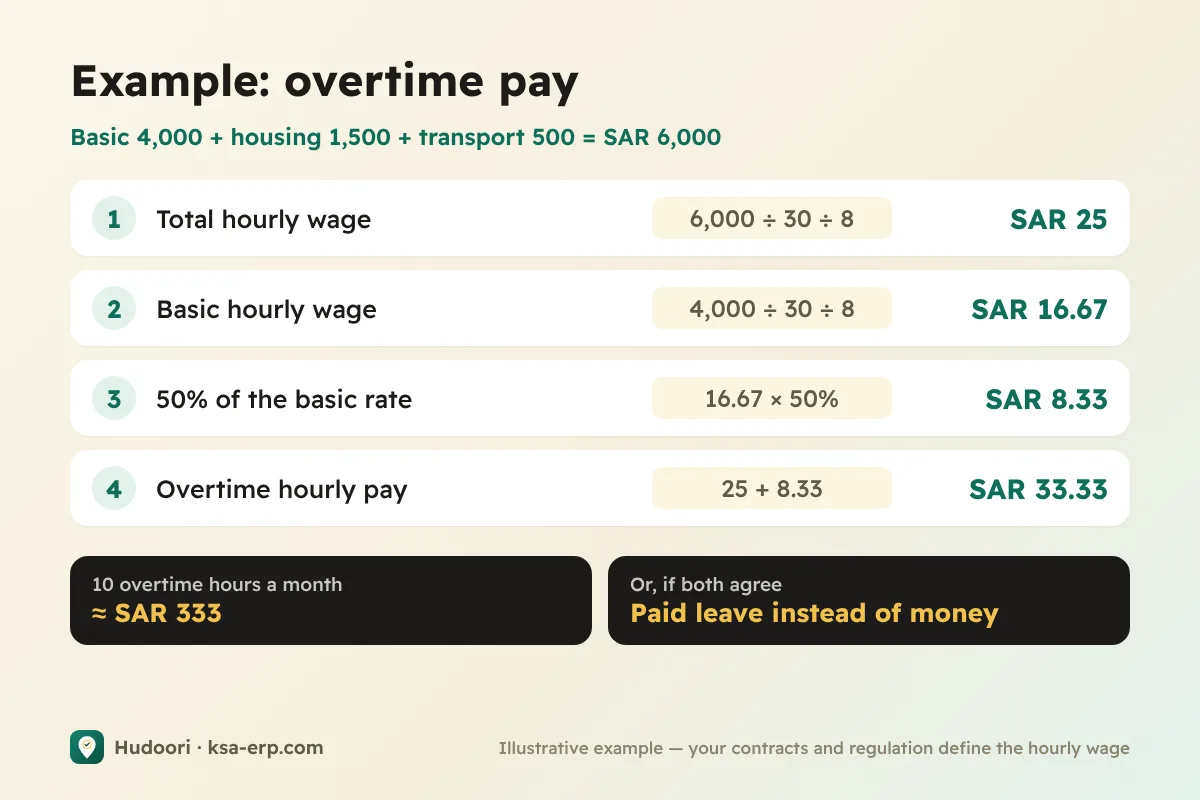
For each overtime hour, pay the full hourly wage plus 50% of the basic hourly wage. Note that the 50% is based on the basic wage, not the total with allowances.
Example: an employee has a basic wage of SAR 4,000, housing allowance of SAR 1,500 and transport allowance of SAR 500, for a total of SAR 6,000, working 8 hours a day.
- Total hourly wage = 6,000 ÷ 30 ÷ 8 = SAR 25.
- Basic hourly wage = 4,000 ÷ 30 ÷ 8 ≈ SAR 16.67.
- 50% of basic hourly ≈ SAR 8.33.
- Overtime hour = 25 + 8.33 ≈ SAR 33.33.
- Ten overtime hours in the month ≈ SAR 333.30.
This is an illustration; define in your contracts which allowances count toward the hourly wage.
Paid leave instead of cash
Since the 2025 amendments, overtime may be compensated with paid leave instead of money, if both parties agree. Document the agreement and track the earned balance.
Shifts and breaks without chaos
Many businesses run several shifts. Good organization means:
- A written shift for every employee: start, end and working days.
- A defined break: time and length, treated according to your regulation.
- A clear overtime rule: most companies require prior manager approval so every minute after hours doesn't become overtime.
- Consistent rounding: minutes or half-hours, applied to everyone.
How Hudoori calculates hours and overtime automatically
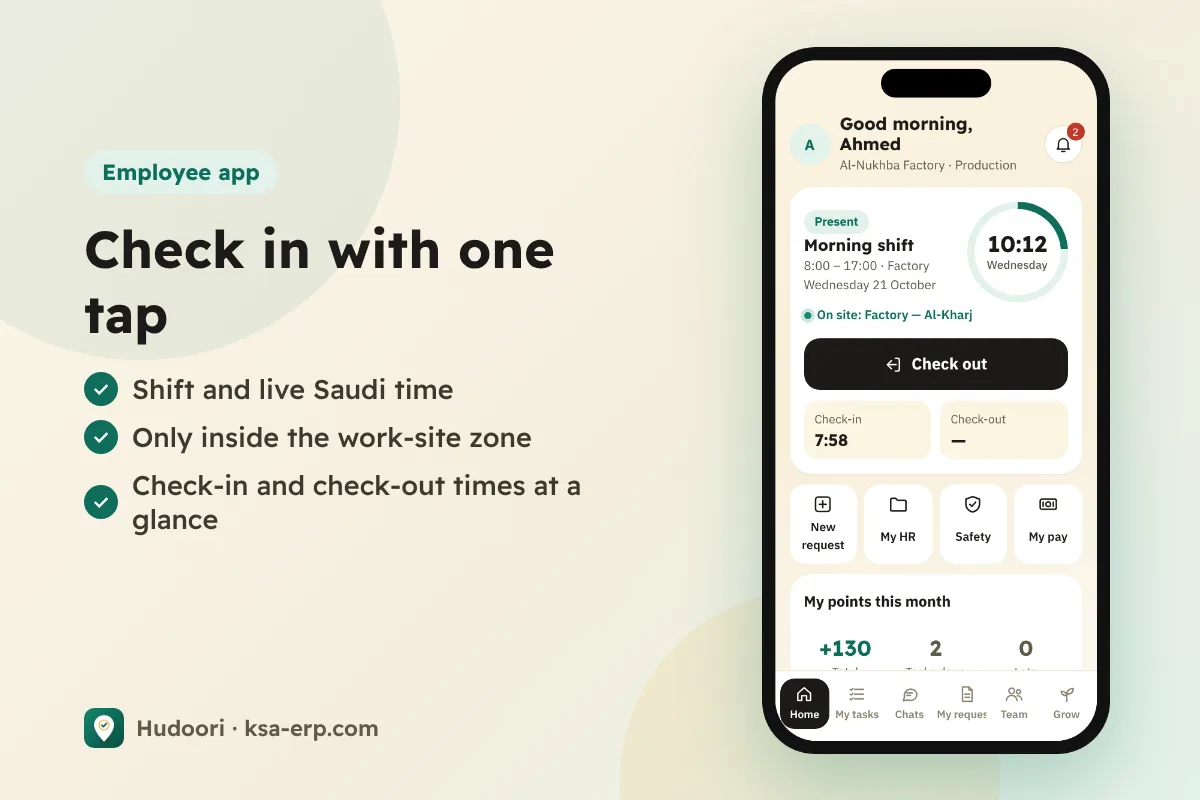
In Hudoori, each employee has an assigned shift and break and checks in and out from their phone inside the site's geofence with a live selfie. The system then calculates actual hours worked, lateness, early leave and absence, plus overtime hours, which flow into payroll according to your own settings.
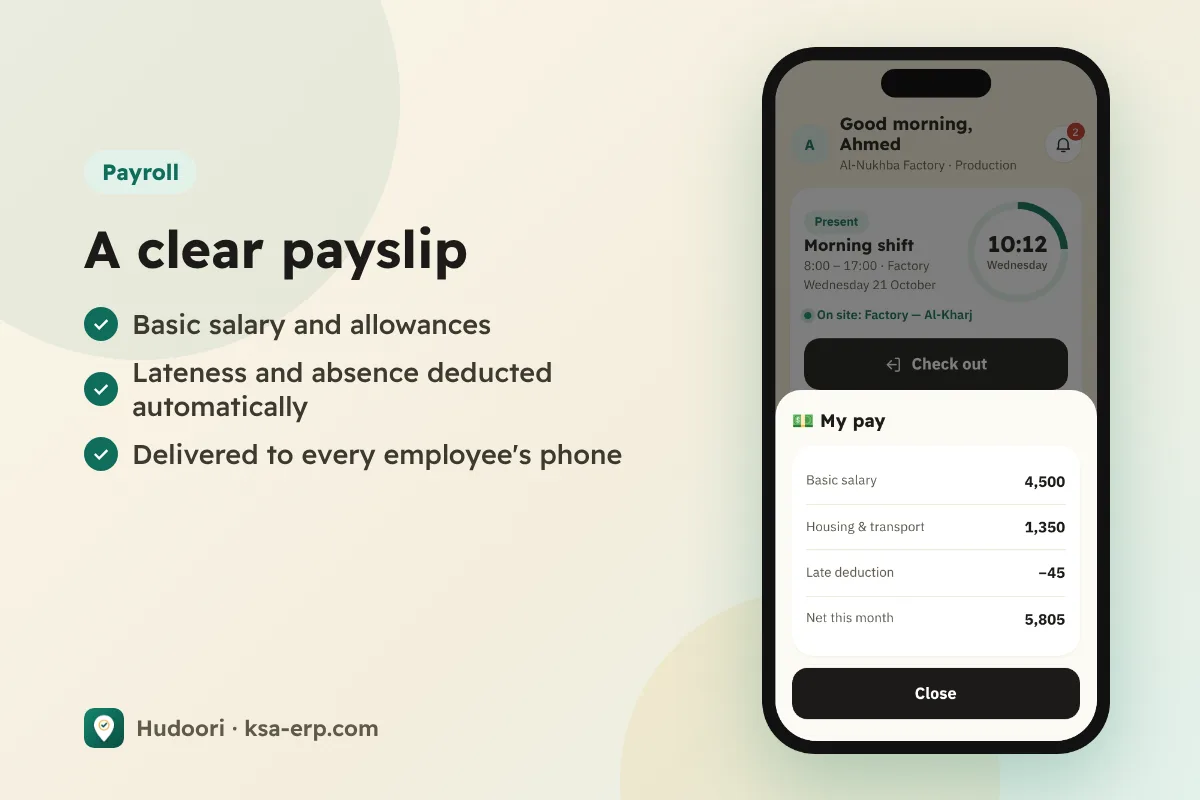
Because the app works offline, an employee at a site with no coverage is still recorded at the correct time, and the data syncs once the connection returns. Managers see who is in and who is late right now, and each employee receives a payslip showing overtime and deductions.
For deduction rules and caps, see absence and lateness deductions. To turn hours and overtime into payroll and a Mudad file, read payroll from attendance.
Monthly HR checklist
- Are shift schedules current for every employee and branch?
- Were Ramadan shifts set up before the month started?
- Does every overtime hour have prior approval under your policy?
- Is there a written agreement with anyone taking leave instead of overtime pay?
- Did you review the overtime report before approving payroll?
FAQ
Do reduced Ramadan hours apply to everyone?
The law reduces them for Muslim employees to 6 hours a day or 36 a week.
Is the 50% based on the total salary?
No. It's based on the basic wage and added to the hourly wage.
Can I give leave instead of overtime pay?
Yes, after the 2025 amendments, if both parties agree and the leave is paid.
Do I need written rules for shifts and overtime?
Yes, in your work regulation and contracts. For details, check with the Ministry of Human Resources (HRSD) and your company's approved work regulation.
Conclusion
Respect both limits, prepare Ramadan shifts early, pay overtime as the hourly wage plus 50% of basic, and document any leave-for-overtime agreement. If you want hours and overtime calculated automatically from each employee's phone, request a free trial of Hudoori.