 Hudoori
Absence and Lateness Deductions Under Saudi Labor Law
How to calculate absence and lateness deductions from salary fairly and within Saudi labor rules, from the daily wage to deduction caps and written warnings. Includes worked examples and an HR checklist.
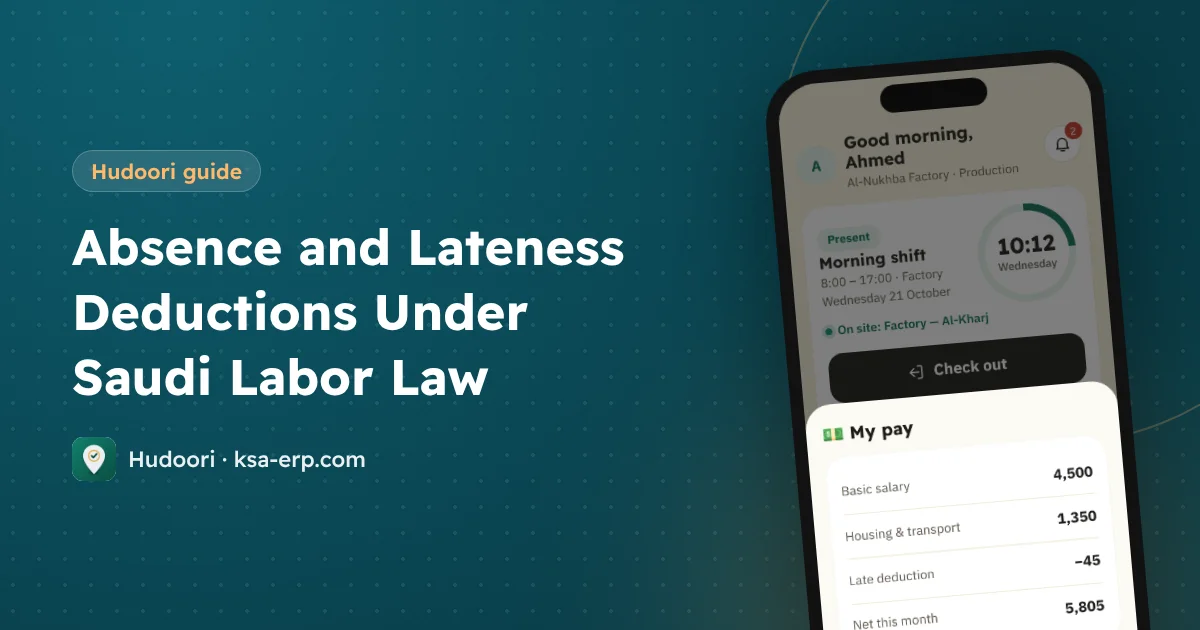
In Saudi Arabia, absence and lateness deductions start from one rule: daily wage = monthly wage ÷ 30. You then apply only the penalties in your company's approved work regulation, within fixed caps: total deductions can't exceed half the wage, and fines can't exceed five days' pay per month.
Why deductions cause friction
The math is rarely the problem. The trouble comes from having no written rule, unreliable attendance data (paper sheets, buddy punching, devices that don't cover field sites), and mixing two different things: not paying for time not worked, and a disciplinary penalty from the violations table. Each has its own logic and limits.
Daily and hourly wage
Divide the monthly wage by 30, whatever the month's length, then by your approved daily hours for an hourly rate.
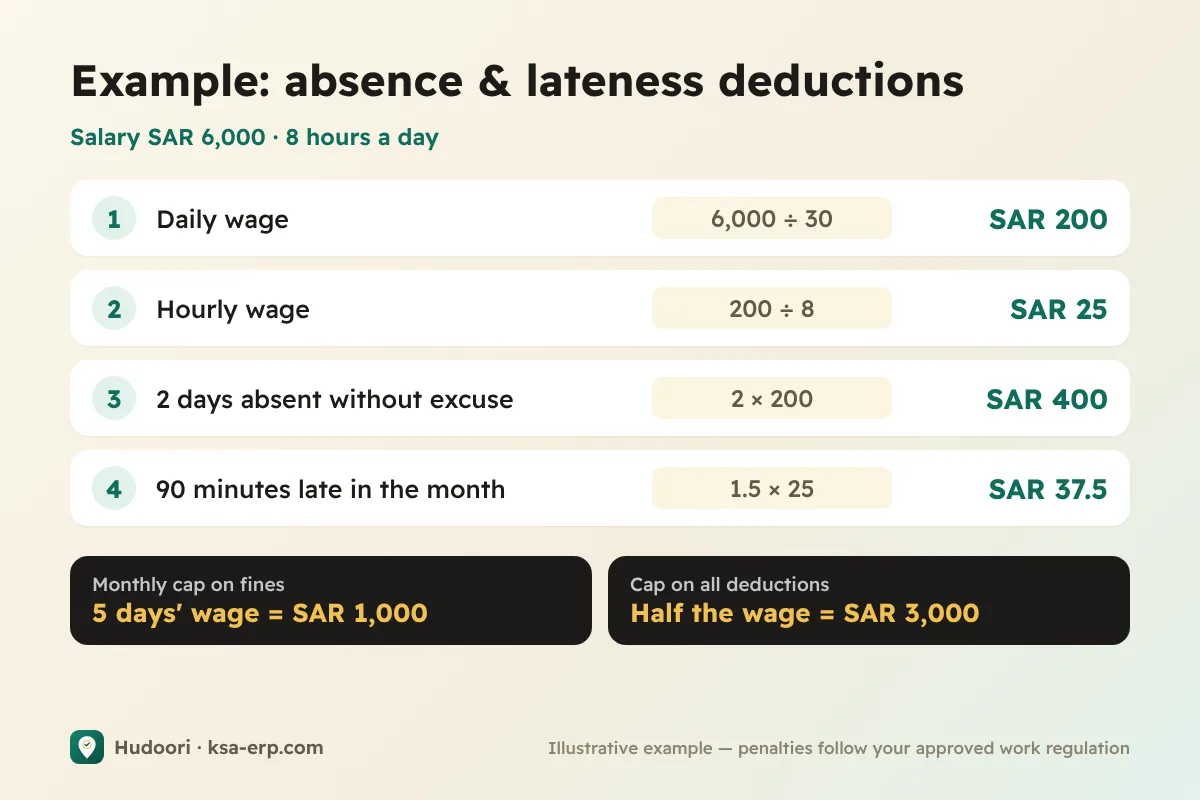
Example: an employee earns SAR 6,000 and works 8 hours a day.
- Daily wage = 6,000 ÷ 30 = SAR 200.
- Hourly wage = 200 ÷ 8 = SAR 25.
Absence deductions
Approved leave or documented sick leave follows the rules of that leave type. Unexcused absence is normally deducted, with an extra penalty only if your work regulation lists one.
Example: the same employee is absent two days without excuse. Deduction = 2 × 200 = SAR 400, plus any penalty from your approved table.
Article 80: when absence leads to dismissal
An employer may dismiss without end-of-service award if the employee is absent without a valid reason for more than 30 non-consecutive days in a contract year, or more than 15 consecutive days. The condition: a written warning must be issued after 20 non-consecutive days or 10 consecutive days. An accurate, dated absence record is what makes this provable.
Lateness deductions
The fairest common approach is to deduct the minutes actually missed, with progressive penalties for repeated lateness as defined in your violations table.
Example: total lateness in the month is 90 minutes. At SAR 25 per hour, the deduction is 1.5 × 25 = SAR 37.50. If your regulation calls for a written warning on the third late arrival, record the warning and deduct nothing beyond what the table allows.

The caps you must respect
- Total deductions may not exceed half of the wage due (Article 92), unless the competent authority decides otherwise. That total includes everything, loan installments too.
- A fine for a single violation may not exceed five days' wage.
- No more than five days' wage may be deducted for fines in one month.
- Penalties apply only as listed in your approved work regulation.
Example: on a SAR 6,000 salary, monthly fines are capped at SAR 1,000 and total deductions at SAR 3,000.
Checklist before deducting anything
- Is the absence or lateness backed by reliable, timestamped attendance data?
- Was there approved leave or a permission on that day?
- Does the penalty actually exist in your approved violations table?
- Are total deductions under half the wage, and fines under five days' pay?
- Is the written warning saved in the employee's file?
Automating it
With Hudoori, employees check in from their phone inside the work site's geofence with a live selfie, so the data is trustworthy from the start. Lateness and absence are calculated automatically from each employee's shift, and deductions flow into payroll per your own settings. A WhatsApp reminder goes out before anyone is marked absent, cutting absences caused by forgetfulness. See WhatsApp attendance reminders.
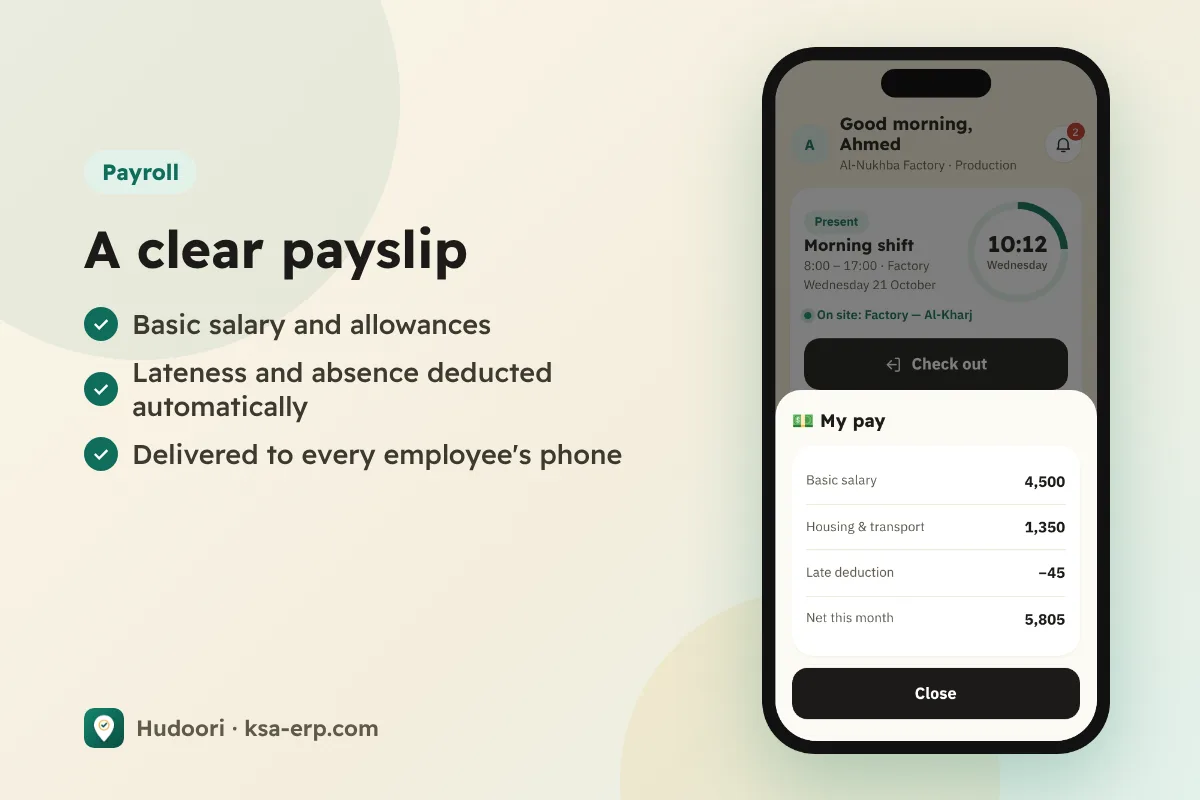
Every employee receives a payslip showing what was deducted and why. For payroll and the Mudad file, read payroll from attendance. Warnings and violations are kept in the employee file, covered in HR records and document expiry.
FAQ
Do I divide by 30 or by the actual days in the month?
By 30, whether the month has 28 or 31 days.
Can I deduct more than half the salary if there are many violations?
No. Total deductions stay within half the wage due unless the competent authority decides otherwise, and fines stay within five days' pay per month.
Can I dismiss after 15 consecutive days of absence straight away?
A written warning after 10 consecutive days is required first. For details, check with the Ministry of Human Resources (HRSD) and your company's approved work regulation.
Conclusion
Fair deductions rest on reliable attendance data, a written regulation everyone knows, and respect for the legal caps. Divide by 30, separate unpaid time from penalties, and document warnings on time. If you'd like all of this handled automatically, from the employee's phone to the payslip, request a free trial of Hudoori.