 Hudoori
Payroll from Attendance Data: From Deductions to the Mudad File
Most payroll errors start when attendance is copied by hand into a spreadsheet. A practical guide to payroll that starts from attendance itself: deductions, overtime and advances, then payslips, the wage protection file and the accounting entry.
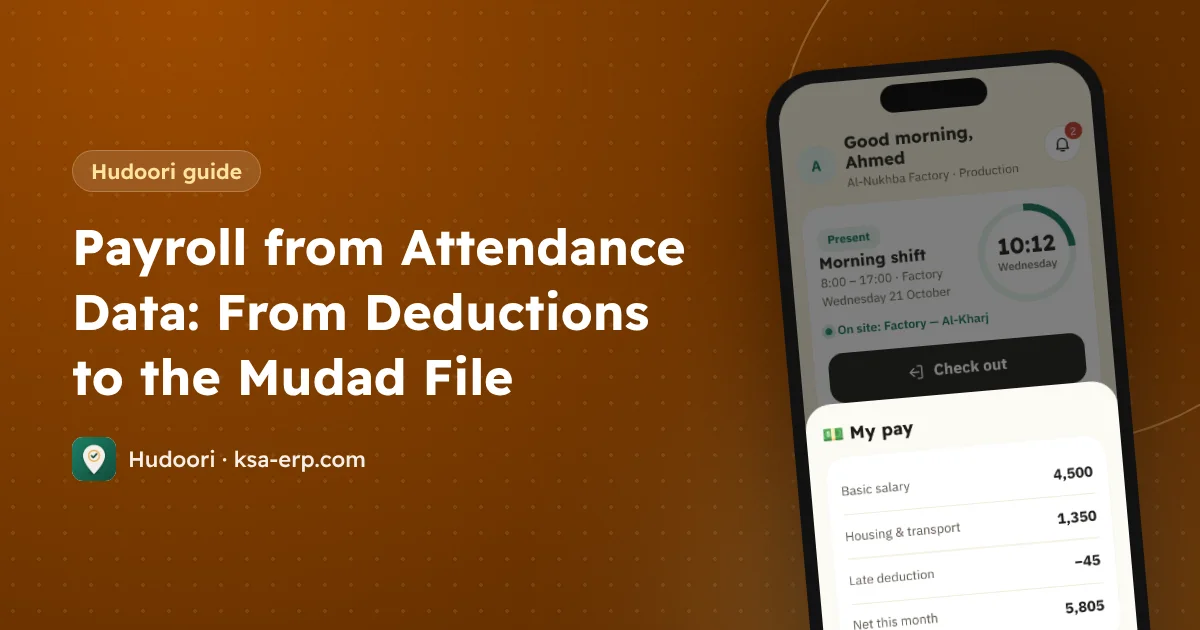
Accurate payroll starts from attendance data itself, not from a spreadsheet filled in at month end. When deductions, overtime and advance installments are calculated automatically from attendance and your company settings, what remains is to review and approve, then upload the wage protection file and post the accounting entry.
Where payroll usually goes wrong
In many small and mid-sized companies, pay travels like this: fingerprint device or paper sheet, then someone totals lateness in Excel, then the accountant adds overtime and advances, then the bank file, then the accounting entry. Every hand-off invites an error:
- Absence that wasn't: approved leave never reached the accountant.
- Wrong overtime because shift hours were unclear.
- An advance installment forgotten or deducted twice.
- A wage file that does not match what was paid.
- Employees who do not understand their pay and come asking.
The fix is not a more careful accountant; it is fewer manual hand-offs.
Legal principles your payroll must respect
- Daily wage = monthly wage ÷ 30.
- Working hours: 8 a day or 48 a week; in Ramadan for Muslims, 6 a day or 36 a week.
- Overtime: the hourly wage plus 50% of basic pay. Since the 2025 amendments, paid leave may replace cash by mutual agreement.
- Deduction cap: total deductions may not exceed half the wage due (Article 92) unless the competent authority decides otherwise.
- Fines: no more than five days' wage per violation, and no more than five days' wage in fines per month, applied under your approved work regulations.
- Wage protection: pay through banks and upload the wage file to Mudad.
For details, refer to the Ministry of Human Resources (HRSD) and your company's work regulations.
Worked examples
Illustrative only; your settings and regulations decide the actual numbers.
Absence
Salary 6,000 SAR, so the daily wage is 200 SAR. Two unexcused days mean a 400 SAR deduction, plus any penalty your regulations specify.
Lateness
Same employee, 8-hour shift: 25 SAR per hour. Three hours of lateness in a month means 75 SAR, unless your regulations set a grace period. More in absence and lateness deductions.
Advance installments
A 3,000 SAR advance over 6 months is 500 SAR a month. In a month with other deductions, check the total stays under half the wage due.
How Hudoori builds payroll automatically
- Attendance and shifts: lateness and absence are calculated automatically.
- Approved requests: leave and permissions are requested and approved in the same system, not lost in a separate paper trail.
- Deductions and overtime follow your company settings.
- Advances: requested from the phone, approved by the manager, installments deducted when the month is approved.
- Month approval: you review and approve, and every employee receives a payslip.
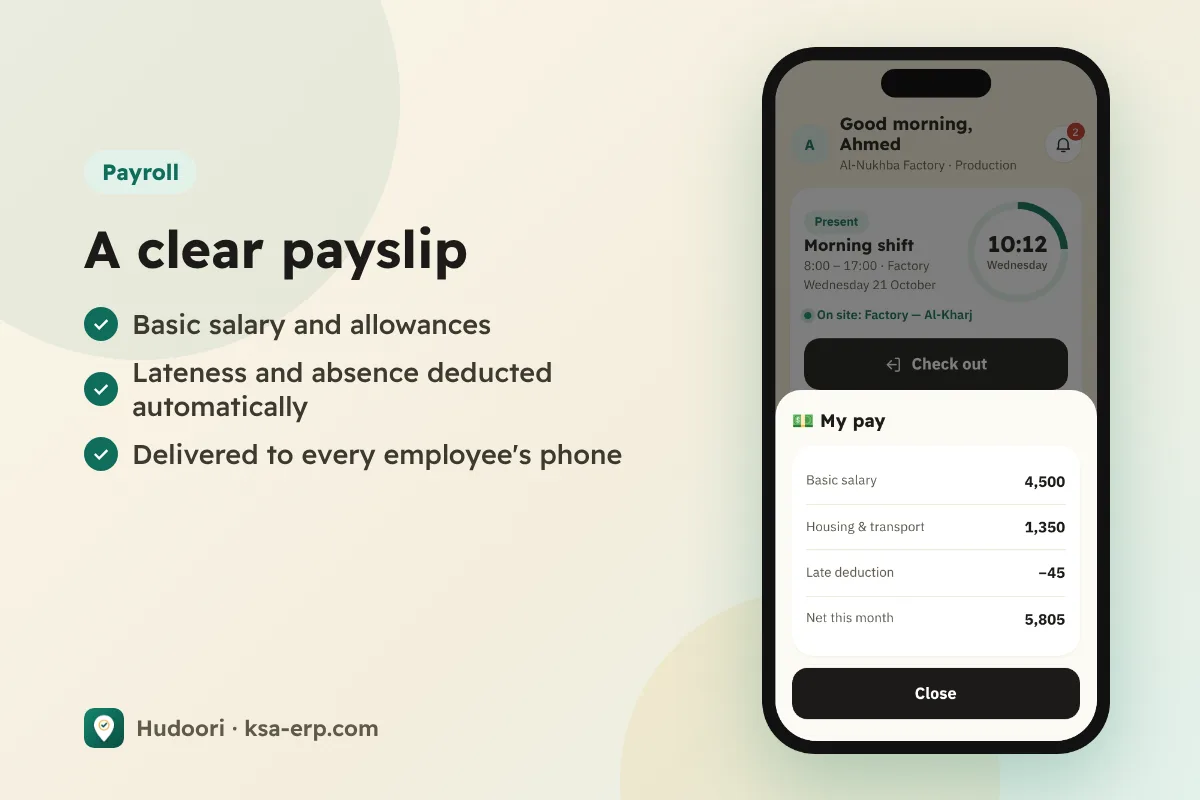
When employees see their basic pay, allowances, lateness deduction and net in their own language, "why is my salary short?" visits drop, and the attendance record answers the rest.
The Mudad file and the journal entry
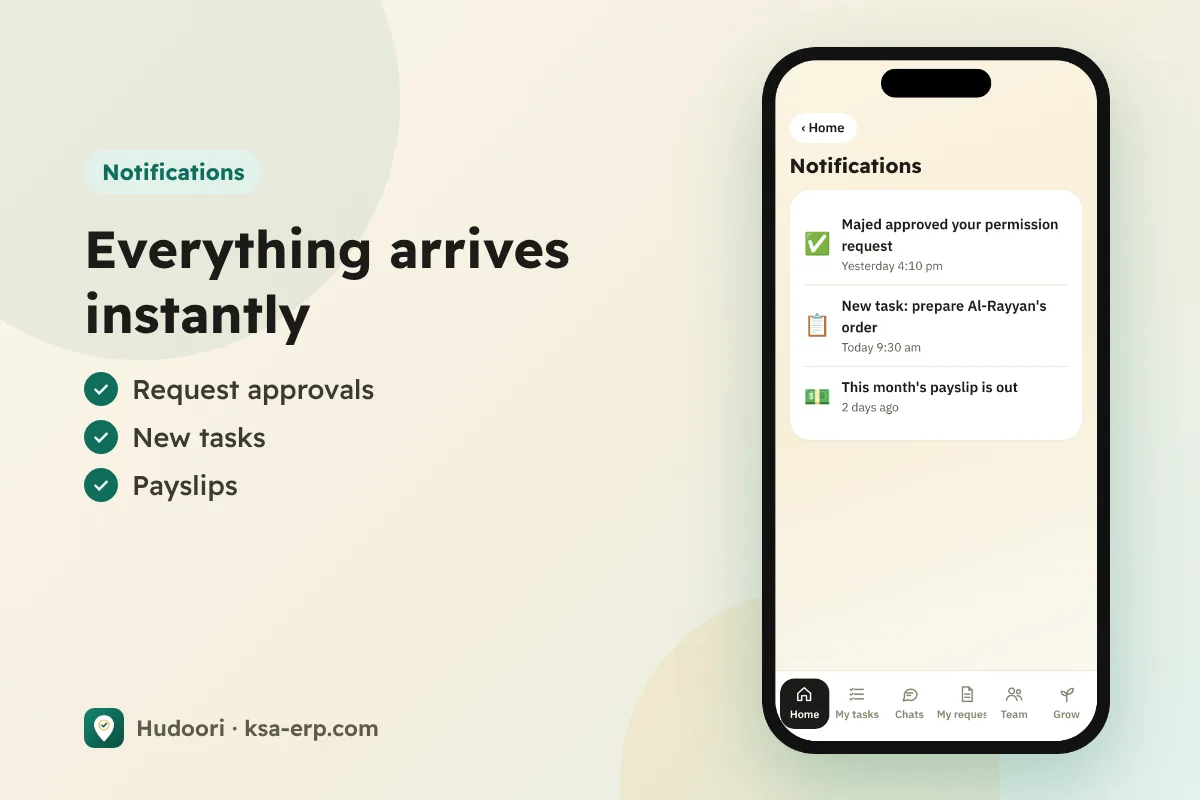
Hudoori produces the Mudad wage protection file from the same approved payroll, so it matches what was actually paid. The payroll journal entry goes to the Qoyod accounting software, so nobody re-keys totals.
Monthly checklist before approval
- Are shifts up to date, especially in Ramadan?
- Are all pending leave and permission requests decided?
- Are joiners and leavers recorded with correct dates?
- Are advance installments right?
- Does anyone exceed the half-wage cap?
- Was overtime pre-approved under your policy?
- After approval: upload Mudad, post the entry, confirm payslips arrived.
Still on a fingerprint device? See our guide to mobile attendance systems.
FAQ
Are deductions final without review?
No. They are calculated automatically, but you review and approve the payroll.
Does the Mudad file replace bank payment?
No. Salaries are paid through the bank; the Mudad file documents them for wage protection.
When are advance installments deducted?
When the month is approved, per the agreed number of installments.
Conclusion
Good payroll starts with the first check-in. When attendance, requests and advances feed payroll directly, deductions and overtime follow your settings, and the Mudad file and accounting entry come from the same data, closing payroll becomes review and approve. See it with your own team: request a free trial of Hudoori.